Groundwater flows basically according to the heat equation. The model knows the direction of water flow, even though there is no reference to gravity g. Initially, during derivation, upward direction is chosen and the head h accordingly. We assume more variation in horizontal direction than lateral, and use Darcy's law. The length scales are also larger in horizontal direction than vertical for typical reserviors.
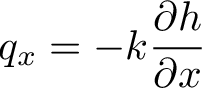
The flow in an aquifier is described by the term specific discharge, and is commonly given by Darcy's emperical law, which relates the flow to the slope of the groundwater head
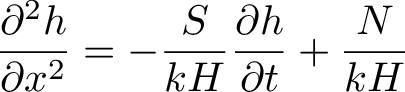
Darcy's law, along with the continuity equation and Dupuit approximation, leads to the Boussinesq equation for 1D aquifier flow
Analytical solution, based on some assumptions such as infinite direction in x

The erfc is the complementary error function. The analytical solution can be used for some scenarios which are investigated in the examples below. I'm more curious about the numerical methods, in this case finite-difference methods, but the analytical solutions are very important to validate
Example 1 groundwater drains out
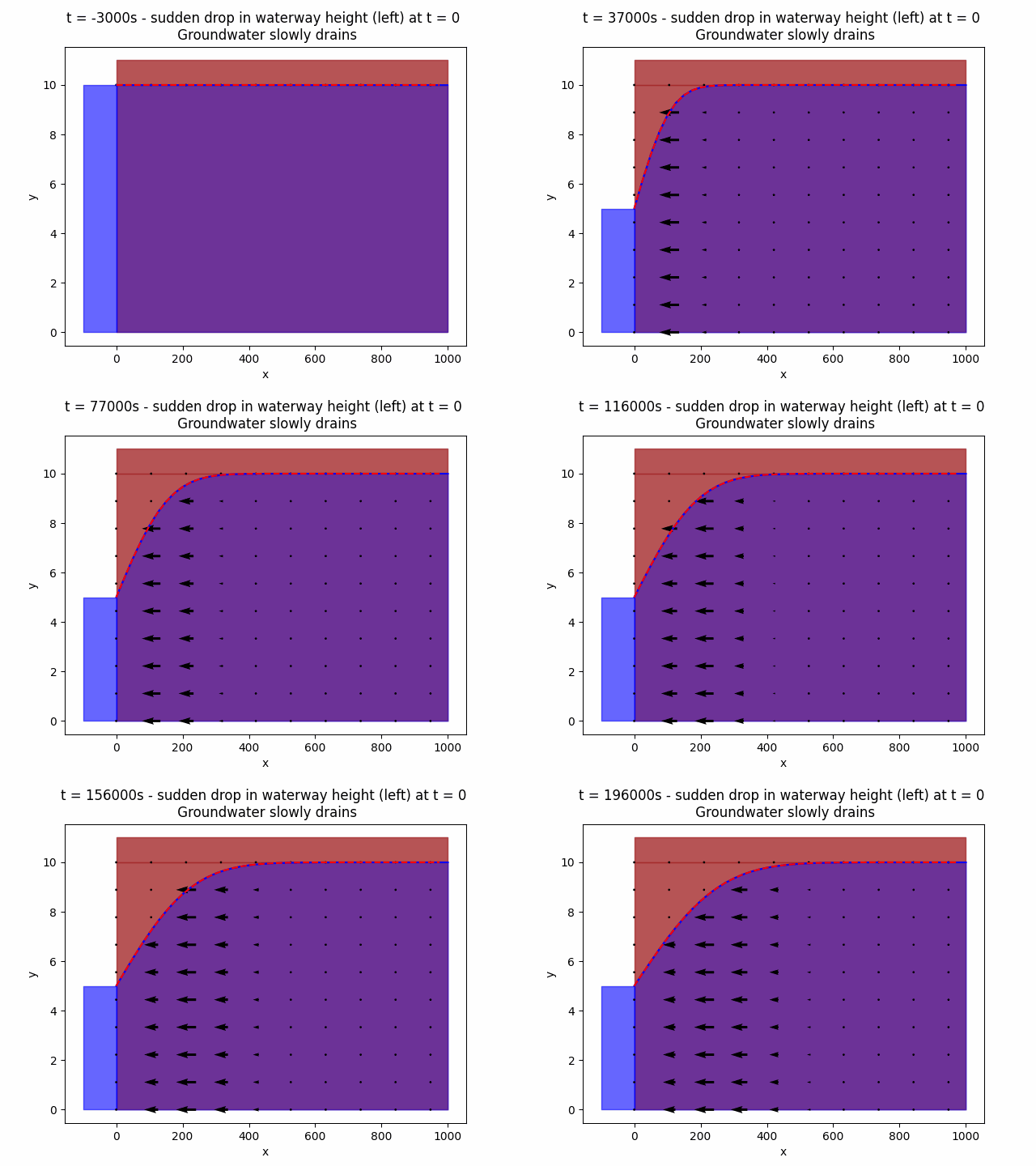
Water canal to the left,where water is lowered to height h. The groundwater will flow to the water canal over time.
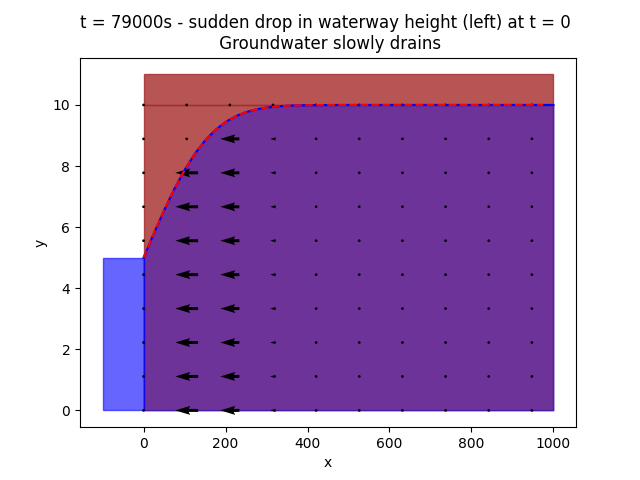
The time development is seen below. At t = 0, the water to the left of the reservoir is suddenly lowered, and water from the reservoir will diffuse to the left.
Example 2 draining on both sides (Poisson equation)
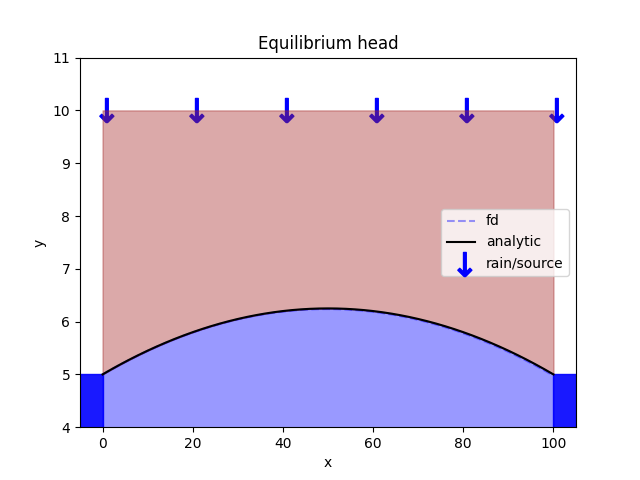
In this case we solve for the equilibrium situation, with source term N (representing e.g rain). This means that water fills from above the reservoir, from e.g rain.
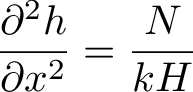
The solution for some boundary conditions is given below:
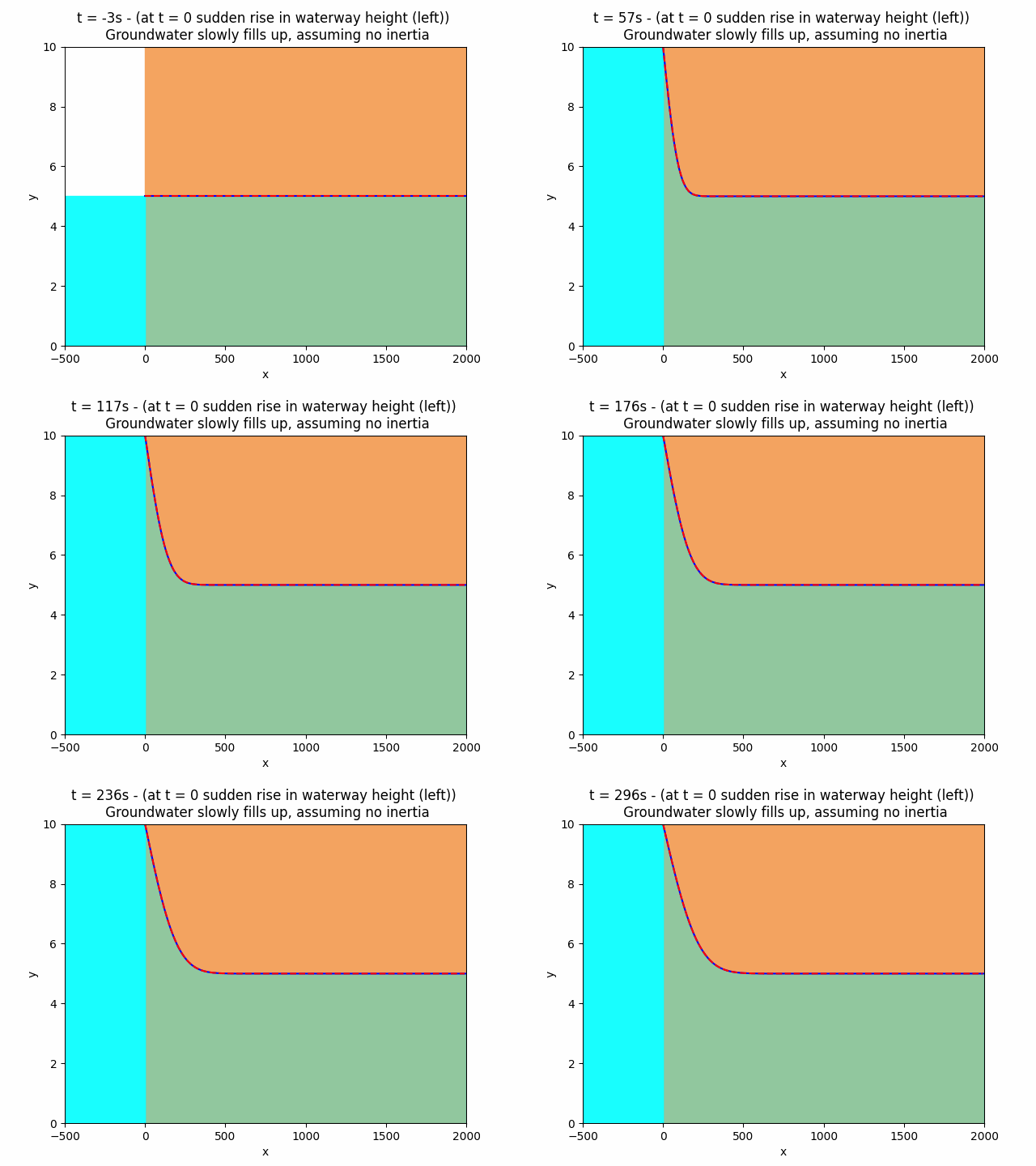
Example 3 groundwater fills up
In this situation, water suddenly rises at t = 0, and diffuses into the resorvior over time
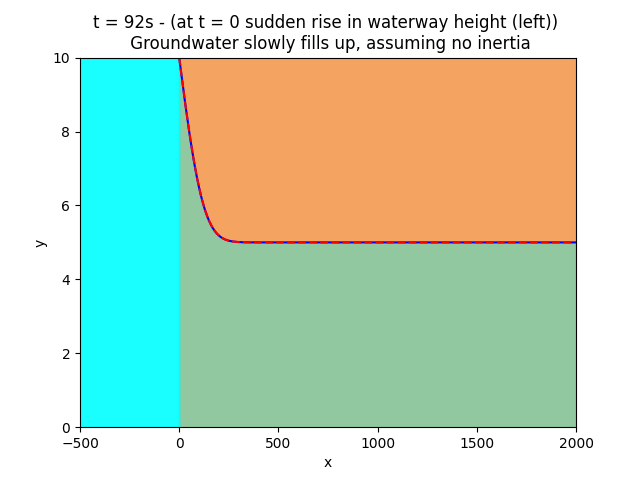
Full time development can be seen below, from some time before t = 0, and then at t = 0, a sudden increase in water height. The flow inward into the reservior can be observed.